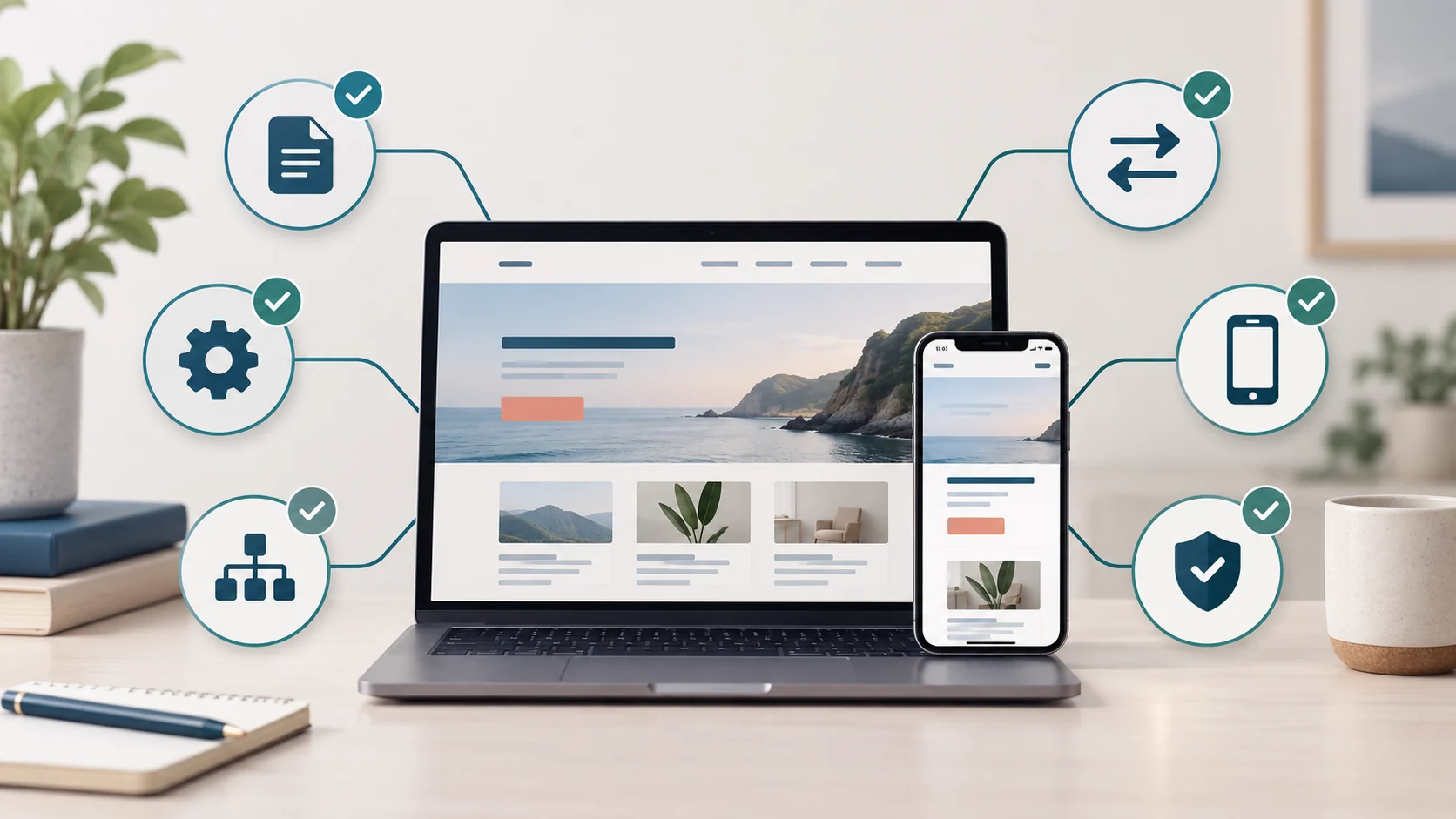
Evaluate the published website, its editing controls and its migration options before committing to an AI builder.
What does SEO-friendly mean in practice?
A polished preview is only the starting point. Customers need pages that answer their questions, while a site owner needs dependable URLs, editable content and a way to fix errors. Google’s technical requirements describe basic eligibility for Search; satisfying them does not guarantee indexing or rankings.
This is a platform-independent acceptance checklist, not a tested ranking of current builders. Features can differ by plan, integration and publishing configuration. Ask a supplier to demonstrate the controls on a published example rather than relying on a feature list.
Six tests before you choose a builder
| Test | Evidence to request | Why it matters |
|---|---|---|
| Page access | A published page with readable main content and no unintended login or indexing restriction. | A working preview does not prove the public page is accessible. |
| Page controls | Demonstrate title, description, slug and indexing settings on one sample page. | You need to correct generated defaults. |
| Navigation | Show how an ordinary linked page can be reached from the site’s navigation. | Important content needs a discoverable route. |
| URL changes | Demonstrate redirect handling when a page address changes. | Redesigns should preserve useful existing destinations. |
| Mobile experience | Test a service page, contact form and image-heavy page on a phone. | Real customer tasks reveal problems hidden by the homepage demo. |
| Ownership | Document domain access, exports, backups and migration limitations. | Future repair or migration depends on these controls. |
Run a realistic acceptance test
Build a small representative site before transferring a large one: a service page, a supporting guide and a contact page. Use your actual offer and page structure. Check that the form arrives at the intended destination, the links work and the mobile navigation exposes every important page.
Then make a normal business change. Rename a service, update a URL and replace a large image. Document how much effort those changes require and whether they introduce broken links. This tests maintainability, which matters long after the first generated design.
Review the content separately from the design
Generated copy often needs business-specific detail: who the service is for, what it includes, what it excludes and how a prospect starts. Replace unsupported claims and stock testimonials with verifiable information. Do not publish invented offices, client names or experience merely because a template supplied them.
For a WooCommerce business, check product variations, availability and the checkout journey as well as editorial pages. If a builder cannot support your operational requirements, a visually attractive landing page will not make it suitable for the store.
Should you repair the site or move to WordPress?
Repair the current site when the required controls exist and the problems are limited. Consider a migration when essential redirects, integrations, content models or ownership requirements cannot be supported. WordPress also needs competent configuration and ongoing maintenance; moving platforms is not an automatic SEO improvement.
Before migrating, retain a URL inventory and decide where each existing page will go. Test the replacement and redirects before switching the domain. The site takeover audit provides a useful framework for checking access and implementation risks.
Common questions
- Does an AI-built site get an automatic search penalty?
- The production method alone does not establish quality. Review the published content against Google’s people-first content guidance.
- Do US businesses need a separate technical checklist?
- The core tests are the same. Local service details, customer expectations and business requirements may differ by market.
Need a technical review before rebuilding?
Explore WordPress development for implementation or SEO support for a review of search requirements.
Discussion
0 comments
No comments yet.
Have a technical question, correction or a different interpretation? Add to the discussion.