
Reading progress
OpenAI has officially introduced textGrain, an invisible text watermarking technology designed to help identify text generated by its AI systems. Announced on October 5, 2026, the technology marks a significant development in AI content provenance—and raises important questions for publishers, SEO professionals, developers, and anyone using ChatGPT to produce written content.
But does this mean every ChatGPT article now contains a hidden watermark? Can Google detect it? Will copying AI-generated content into WordPress preserve the watermark? And can a ChatGPT watermark detector reliably determine whether an article was written by AI?
The answers are more nuanced than many headlines suggest.
The key distinction: OpenAI’s text watermark is not a hidden character, metadata tag, or visible disclosure. It is a statistical pattern introduced during text generation. The technology can provide evidence that an OpenAI system generated or processed text, but it cannot reliably establish authorship, ownership, factual accuracy, or the extent of human involvement.
This guide examines what OpenAI actually announced, how textGrain works, how accurate the detection is, what it means for Google Search, and what website owners should do next.
What Is ChatGPT Text Watermarking?
ChatGPT text watermarking is a technique that embeds a machine-detectable statistical signal into AI-generated writing by influencing how a language model selects words and tokens.
Unlike traditional watermarks applied to images or documents, a text watermark does not need to appear as a visible symbol. It can instead be encoded into patterns across the generated text itself.
OpenAI’s implementation is called textGrain.
When a supported OpenAI model generates watermarked text, its token-selection process introduces a secret-key-dependent statistical relationship. A compatible detector can later examine the text for evidence of that relationship.
The idea is to provide a form of content provenance: information that helps determine whether an AI system was involved in producing the content.
However, text provenance is not the same as proof of authorship.
An article containing a detectable watermark could still have undergone substantial human editing, fact-checking, and restructuring. Conversely, an AI-generated article might contain no detectable watermark.
Is ChatGPT adding watermarks to all generated text?
No.
As of October 9, 2026, OpenAI has announced a phased deployment rather than universal watermarking.
The rollout has three important components:
- ChatGPT in the European Union: Invisible watermarks are being introduced over the coming weeks for eligible text outputs across plans.
- Codex in the European Union: Eligible text outputs are included in the phased deployment.
- OpenAI API worldwide: Customers can opt in to text watermarking for supported models. The feature remains disabled by default.
OpenAI has not announced that text watermarking will become the global default for all ChatGPT users at launch.
The announcement also does not establish that every individual response from an eligible product will necessarily contain a reliably detectable watermark. Content type, length, model support, and deployment coverage matter.
For users outside the EU, including those in the United States or Türkiye, it would be incorrect to assume that every new ChatGPT response is already watermarked.
Official source: OpenAI — Our Approach to EU Text Provenance Rules
Why Did OpenAI Introduce Text Watermarking?
The immediate regulatory context is the European Union’s Artificial Intelligence Act.
The EU AI Act establishes transparency obligations for AI-generated content, including requirements related to machine-readable identification of synthetic material.
Text watermarking is one technical approach that AI providers can use to support those obligations.
OpenAI’s October 2026 announcement explains that the company is adopting a gradual deployment strategy because text watermarking remains an evolving technology.
Several challenges explain that cautious approach:
- Text can be easily rewritten without changing its meaning.
- Short passages may not contain sufficient statistical evidence.
- Detection can produce false positives and false negatives.
- Different languages and content types behave differently.
- A detected watermark does not reveal how much work a human contributed.
OpenAI is therefore separating watermark generation from broader public access to its detection system.
This distinction matters because creating a detectable signal is only part of the problem. Interpreting that signal responsibly is equally important.
How Does OpenAI’s textGrain Watermark Work?
To understand textGrain, it helps to look at how language models produce text.
A language model does not normally retrieve a complete, prewritten answer from a database. Instead, it generates a response sequentially by estimating possible next tokens based on the preceding context.
A token may represent a word, part of a word, punctuation, or another unit of text.
At each generation step, the model assigns probabilities to candidate tokens.
For example, suppose the model is completing this sentence:
“A successful content strategy requires accurate information and…”
Depending on the context, several continuations might be reasonable:
- consistent execution
- thoughtful research
- clear communication
- useful insights
An ordinary sampling process selects among possible continuations according to the model’s probability distribution and generation settings.
Watermarking modifies aspects of this selection process so that choices across the passage contain a statistical signal.
The goal is to influence the pattern without making the text obviously unnatural or significantly reducing response quality.
1. Secret-key-based randomness
textGrain uses secret-key-dependent randomness during token generation.
Rather than attaching a label to the finished text, the watermarking process influences how the next token is sampled.
The detector later uses corresponding secret-key information to evaluate whether the observed token sequence contains the expected statistical relationship.
This is fundamentally different from searching for hidden characters.
2. Vocabulary grouping
According to OpenAI’s technical report, textGrain groups vocabulary tokens into blocks.
The watermarking process can then influence the selection of token groups while preserving relative token probabilities within the selected group.
This reduces computational complexity compared with working independently with every token in the full vocabulary.
3. Entropy-calibrated watermark strength
One of textGrain’s defining technical features is its use of an entropy budget.
In information theory, entropy describes uncertainty in a probability distribution.
For language generation, this relates to how much randomness remains when selecting among possible tokens.
A watermarking method that makes token selection too predictable may reduce the diversity of generated responses.
textGrain addresses this trade-off by limiting the amount of sampling entropy used to create the watermark signal.
Its technical framework employs optimal transport with Kullback–Leibler regularization to control the relationship between watermark detectability and sampling randomness.
Put simply, the system tries to create a detectable signature while retaining flexibility in how the model writes.
4. Statistical detection
A compatible detector examines the text for evidence of the expected keyed pattern.
It does not need to find a special marker such as a zero-width character or an embedded identifier.
Instead, it evaluates whether the token sequence demonstrates statistical relationships that would be less likely under an appropriate non-watermarked baseline.
This is why a watermark can potentially survive straightforward copying.
It is also why changing enough words can weaken detection.
Technical reference: textGrain: Entropy-Calibrated Watermarking for Language Model Text (PDF)
Does ChatGPT Watermarking Add Hidden Unicode Characters?
No.
This is one of the most important misconceptions to address.
OpenAI explicitly states that textGrain does not rely on inserting hidden characters, invisible spaces, unusual punctuation, or extra watermark-specific tokens.
The watermark is encoded through the statistical structure of generated wording.
That means techniques designed to discover invisible Unicode characters do not constitute valid textGrain detection methods.
For example, checking a passage for zero-width spaces, byte-order marks, or unusual nonprinting characters may reveal formatting artifacts. It does not establish whether the passage contains an OpenAI textGrain watermark.
Similarly, removing such characters is not evidence that a textGrain watermark has been removed.
The distinction becomes particularly important when evaluating websites advertising AI watermark removal or ChatGPT watermark detection.
A tool that only scans for invisible characters should not claim to detect textGrain.
How Accurate Is OpenAI’s textGrain Detector?
OpenAI’s initial published results show encouraging detection performance under specific experimental conditions, alongside major limitations.
The most important factors include text length, subject matter, language, and subsequent editing.
Detection accuracy by text length
OpenAI evaluated watermark detection in passages of different lengths, using a target false-positive rate of 1%.
For content such as psychology explanations, the company reported approximately:
| Passage length | Watermark detection rate |
|---|---|
| 200 tokens | 80% |
| 400 tokens | 95% |
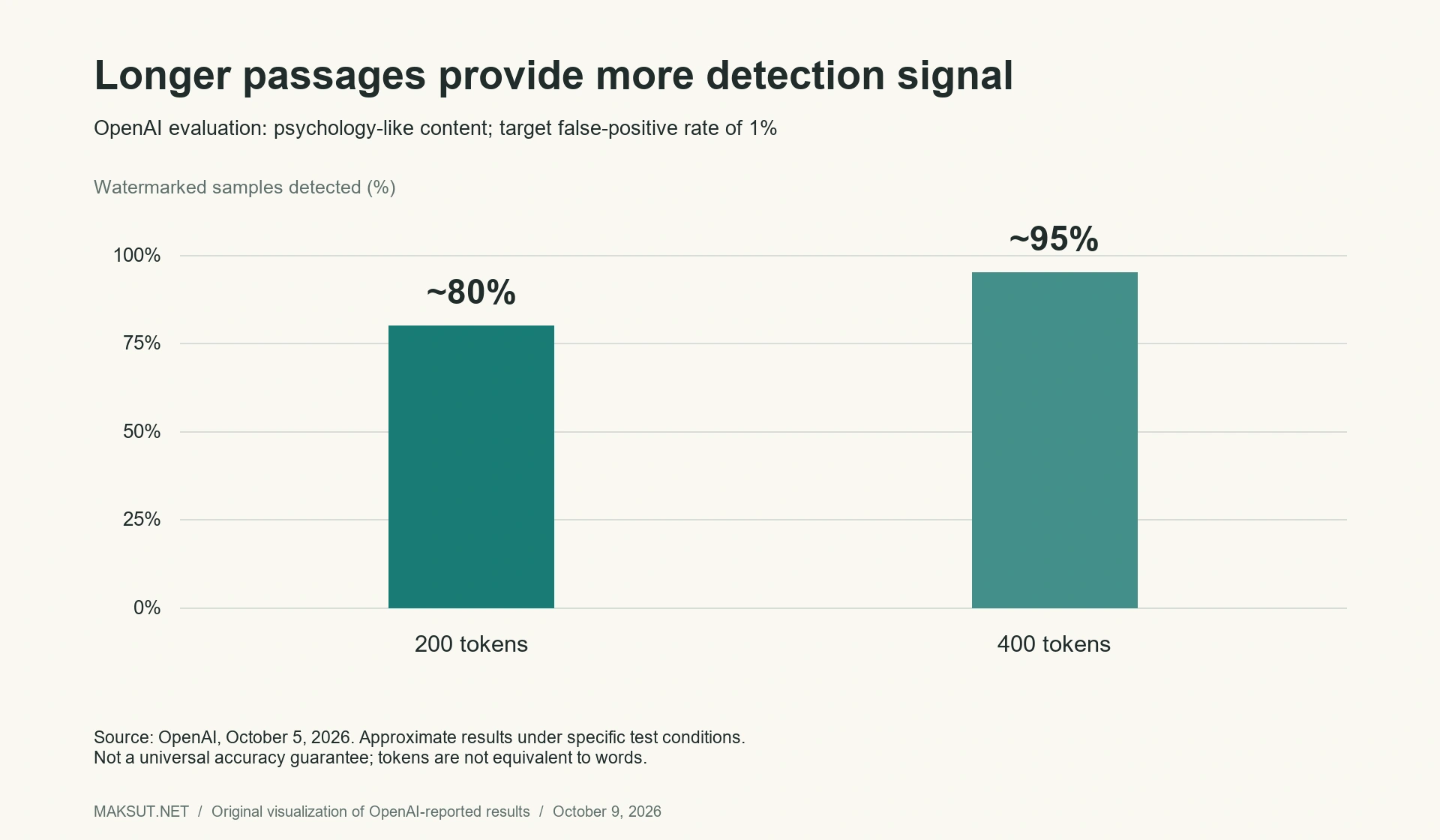
These figures describe performance in OpenAI’s reported evaluation conditions, not a guaranteed detection rate for arbitrary text published online.
A 95% detection rate does not mean that the detector is 95% certain of authorship whenever it returns a positive result.
It means that, for the relevant test set and threshold, the detector successfully identified approximately 95% of the watermarked samples.
The real-world reliability of a positive result also depends on factors such as the prevalence of watermarked content and how the detector performs on unrelated text.
What happens when the text is edited?
OpenAI also tested the impact of replacing words with synonyms in 400-token passages.
| Modification | Detection rate |
|---|---|
| Original watermarked text | Approximately 92% |
| 10% of words replaced | Approximately 66% |
| 25% of words replaced | Approximately 17% |
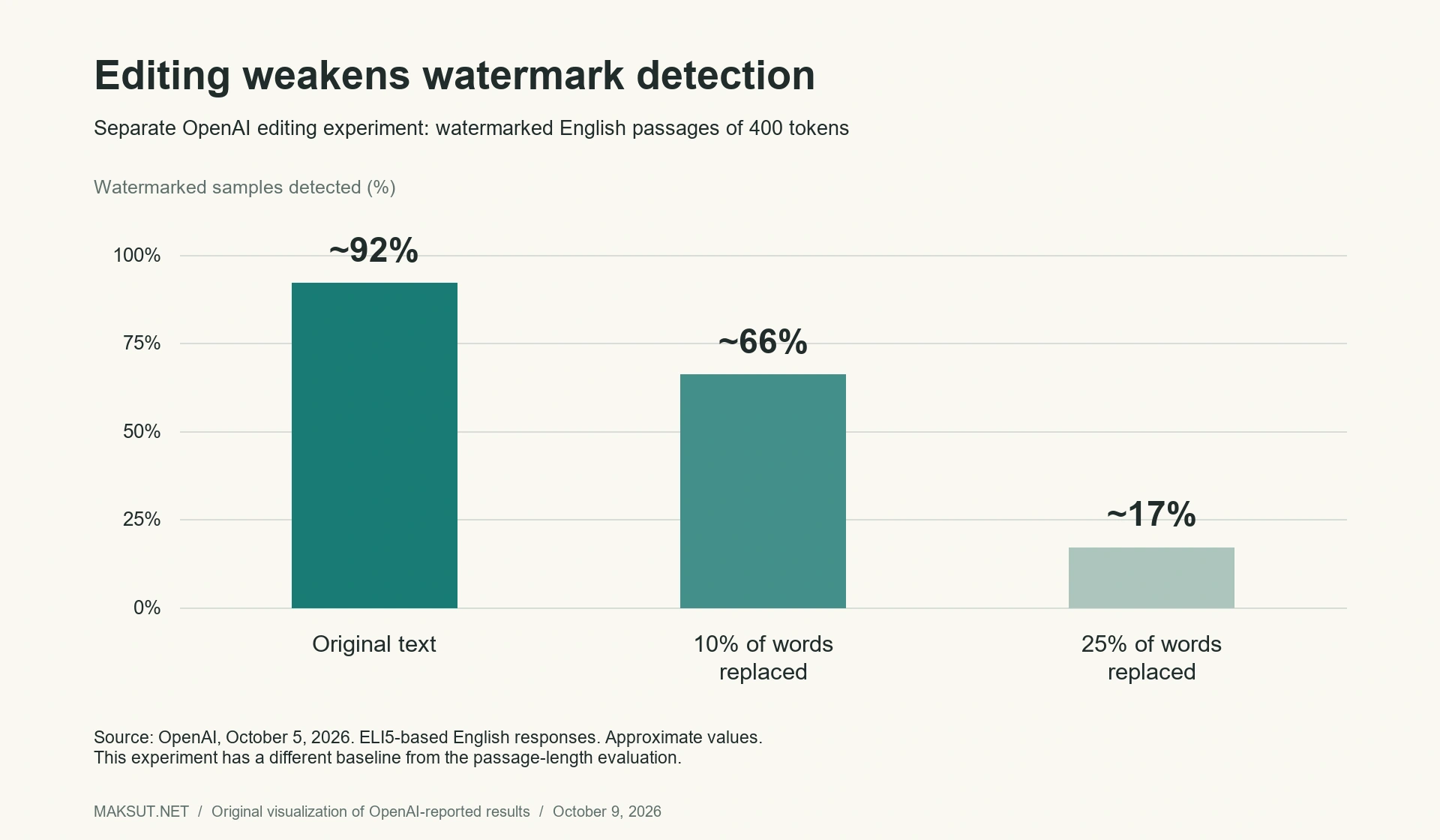
These results reveal an important limitation: watermark detection can deteriorate substantially even when the overall meaning of the text remains similar.
The figures come from specific tests using English responses. They should not be interpreted as universal predictions for every language, model, or editing method.
Why does shorter text cause problems?
A statistical detector needs enough observations to distinguish a meaningful pattern from ordinary variation.
Short text provides fewer opportunities to accumulate evidence.
A two-sentence product description, social media caption, or brief answer may not contain enough signal for reliable detection.
OpenAI also reports weaker detection for highly constrained content, including mathematics, where there are fewer acceptable ways to express certain answers.
Code presents similar difficulties because syntax and functional requirements restrict token choices.
What about other languages?
OpenAI reports that detection performance varies across languages.
Its Help Center describes evaluations covering the 24 official EU languages, with substantial variation in detection rates and an adjustable watermark-strength parameter.
Results measured on one language should not automatically be applied to another.
In particular, the English editing results do not establish equivalent performance for Turkish or other languages.
Source: OpenAI — Provenance Signals in OpenAI-Generated Content
Can You Detect a ChatGPT Watermark?
In principle, yes. In practice, public access is currently limited.
OpenAI has announced a textGrain detector, but it is not launching the detector as an unrestricted public tool.
Initially, access is available through applications for approved researchers and expert organizations.
This controlled rollout is intended to support evaluation of detector accuracy, interpretability, and responsible deployment.
It also reflects the risks of inaccurate detection.
A false positive could result in a person being incorrectly accused of using AI. A false negative could create unjustified confidence that a passage was written entirely by a human.
Is there an official ChatGPT watermark checker?
As of October 9, 2026, the October 5 announcement describes application-based detector access for approved researchers and expert organizations, rather than an unrestricted public textGrain checker.
OpenAI offers separate provenance verification tools for supported images and audio.
Those tools should not be confused with the restricted text watermark detector.
Can third-party AI detectors identify textGrain?
General AI content detectors and textGrain detectors operate differently.
A conventional AI detector may classify text using linguistic or statistical features associated with machine-generated writing.
A textGrain detector is designed to identify a specific embedded, keyed watermark signal.
The two approaches answer different questions.
A generic AI detector reporting that a passage is likely AI-generated does not prove the presence of an OpenAI watermark.
Likewise, a negative result from an ordinary AI detector does not demonstrate that textGrain is absent.
Any service claiming to provide official OpenAI watermark detection should explain its access, methodology, validation data, and limitations.
Source for both experiments: OpenAI’s October 5 announcement. Maksut.net redrew the reported values in the two charts above; we did not conduct an independent detector experiment. The 95% passage-length result and 92% editing baseline belong to separate evaluations and should not be combined.
ChatGPT Watermarking vs. Traditional AI Content Detection
| Feature | textGrain watermark detection | Conventional AI text detection |
|---|---|---|
| Primary purpose | Detect a deliberately embedded watermark | Estimate whether text resembles AI-generated writing |
| Signal source | Keyed generation-time statistical pattern | Learned or engineered linguistic features |
| Secret key required | Required for official textGrain detection | Generally not |
| Works on all AI-generated text | No | Attempts broader classification, with limitations |
| Affected by rewriting | Yes | Yes |
| Can produce false positives | Yes | Yes |
| Proves human authorship | No | No |
| Public access | Restricted at launch | Many third-party tools available |
Neither approach should be treated as conclusive proof of who wrote a document.
This matters in education, hiring, publishing, and editorial review, where an incorrect authorship accusation can have significant consequences.
A reliable assessment should consider the available evidence, documented workflows, and context rather than relying on one automated score.
Will Copying ChatGPT Text into WordPress Preserve the Watermark?
Potentially, yes.
Imagine that a content editor uses an eligible, watermarked ChatGPT output to create a 1,500-word article.
They copy the generated text into the WordPress block editor, add headings, include links, and publish the article.
Because textGrain is encoded through word-selection patterns, the signal may remain detectable if enough of the original text survives.
WordPress does not need to store a separate watermark field for this to happen.
The content itself carries the potential statistical evidence.
However, successful detection is not guaranteed.
Different publishing actions have different implications
| Publishing action | Likely implication |
|---|---|
| Copying text without changing the wording | May preserve the signal |
| Converting text to HTML paragraphs | Formatting alone does not necessarily remove it |
| Adding headings and links | Existing wording may retain signal |
| Fixing a few spelling mistakes | Could weaken a small portion of the signal |
| Rewriting substantial sections | Can substantially weaken detection |
| Translating the article | Detection may become unreliable |
| Replacing most of the original text | Original watermark signal may no longer be detectable |
These are technical expectations, not independently validated WordPress-specific detection results.
WordPress themes, SEO plugins, and content management systems are not inherently responsible for creating or removing textGrain.
The primary question is whether the published wording still contains enough of the original watermark pattern.
Does WordPress automatically reveal the watermark?
No standard WordPress feature exposes an OpenAI textGrain watermark.
A site’s source code, post metadata, and rendered HTML do not necessarily contain an explicit marker announcing that the article is watermarked.
Finding a watermark requires an appropriate detection method, not simply inspecting page source.
Does Google Detect ChatGPT Watermarks?
The official OpenAI and Google documentation reviewed for this guide does not state that Google Search uses textGrain as a ranking signal. That is a limit of the available documentation, not proof of what Google can or cannot detect internally.
OpenAI’s announcement concerns content provenance and AI transparency.
It does not announce a partnership with Google Search to use textGrain for ranking websites.
Google’s published guidance continues to emphasize content quality, accuracy, relevance, originality, and compliance with its spam policies.
Google does not categorically prohibit content merely because generative AI was used in its creation.
Instead, using AI or automation to produce large volumes of low-value pages for the purpose of manipulating rankings may violate its scaled content abuse policy.
These are separate questions:
- Can an OpenAI watermark provide evidence about how a text was generated?
- Is that text useful, reliable, original, and appropriate for a search result?
A watermark detector addresses the first question, and only within its technical limitations.
Search quality evaluation addresses the second.
There is no established rule that a watermarked article must rank poorly, be deindexed, or receive an algorithmic penalty.
Google’s official guidance: Google Search’s Guidance on Generative AI Content
Can AI-Written Articles Still Rank on Google?
Yes. The use of generative AI does not automatically disqualify an article from appearing in Google Search.
However, a technically correct but generic article may still perform poorly if it contributes little original value.
For publishers, the more meaningful questions are:
- Does the article accurately address the reader’s search intent?
- Does it contain original expertise, experience, research, or useful examples?
- Are important claims supported by trustworthy sources?
- Is the information current?
- Has the content undergone meaningful editorial review?
- Does it provide something readers cannot easily find elsewhere?
AI-assisted writing can be part of a legitimate editorial process.
But publishing large quantities of substantially similar, unreviewed content simply to capture search traffic creates quality and spam-policy risks regardless of watermarking.
A watermark is not a quality score.
It cannot distinguish a carefully researched article from a misleading one.
It also cannot measure whether a human editor improved the text.
For SEO professionals, the appropriate response to textGrain is not to focus on making AI involvement undetectable. It is to maintain a defensible, transparent content production workflow.
Does ChatGPT Watermarking Affect AI Search Visibility?
There is no verified evidence that textGrain directly changes whether a page appears in ChatGPT Search, Google AI Overviews, Perplexity, or other AI-powered search experiences.
Text watermarking and AI search retrieval serve different purposes.
Text watermarking attempts to preserve a signal about the involvement of a particular AI system in generating content.
Search retrieval and answer generation involve finding, interpreting, ranking, summarizing, and citing relevant information.
A text watermark does not by itself establish topical expertise, source authority, accuracy, or relevance.
This distinction is particularly important for Answer Engine Optimization (AEO) and Generative Engine Optimization (GEO).
Website owners should not assume that watermarked text will be penalized by AI search systems or that unwatermarked text will be favored.
Until platforms publish reliable evidence of such behavior, those claims remain speculative.
For practical AI search optimization, focus on clear explanations, original evidence, factual consistency, accessible content, and trustworthy citations.
For the broader framework, read the AEO guide and SEO vs. GEO comparison. Practical AI search visibility improvements concern discovery and evidence, while AI visibility metrics concern measurement. Neither is established by a watermark score.
For practical retrieval and crawler guidance, see the ChatGPT Search SEO guide. Search visibility and text provenance answer different questions.
Can ChatGPT Watermarks Be Removed?
textGrain is not a conventional metadata field that can simply be deleted.
Because its signal is associated with wording, transformations that alter the generated text can weaken detection.
OpenAI’s own experiments demonstrate that replacing words with synonyms substantially reduces detection rates under the evaluated conditions.
However, a reduced detection rate is not proof that a watermark has been completely removed.
Nor does the absence of a detectable watermark establish human authorship.
For publishers, this distinction is essential.
A service promising guaranteed watermark removal may be making claims that cannot be validated without access to an appropriate detector and a defined testing methodology.
More importantly, changing text solely to defeat provenance systems is not a substitute for honest disclosure or meaningful editorial involvement.
Legitimate editing should improve clarity, factual accuracy, structure, and usefulness.
Whether a watermark remains detectable is a separate technical question.
What Happens When ChatGPT Text Is Translated?
Translation can substantially change the token sequence, vocabulary, and phrasing of a passage.
Because textGrain’s detection relies on statistical relationships within the generated wording, translation may make an original watermark more difficult to detect.
Consider a watermarked English article translated into Turkish.
Even if the translation preserves the article’s meaning, the resulting words, sentence structures, and tokenization may differ significantly.
OpenAI identifies translation as one transformation that can interfere with watermark detection.
However, this does not mean every translated passage is guaranteed to become undetectable.
Detection outcomes depend on the system, languages, amount of transformation, and other conditions.
A further distinction is necessary: text that is translated by a watermark-enabled model could potentially be subject to watermarking during that new generation process.
In that scenario, any detectable signal would need to be interpreted in relation to the actual generation workflow.
How Is textGrain Different from SynthID and C2PA?
textGrain is part of a broader effort to establish the provenance of AI-generated material.
Three related technologies are worth distinguishing.
textGrain
textGrain is OpenAI’s text watermarking method.
It embeds a statistical signal into text during generation and requires compatible detection to evaluate that signal.
Its focus is AI-generated or AI-processed text.
SynthID
SynthID is a family of watermarking technologies developed by Google DeepMind.
It includes techniques for embedding signals into supported AI-generated media, including text in relevant implementations.
OpenAI states that textGrain matched or exceeded the performance of approaches it tested, including SynthID for text, under the company’s evaluation conditions.
That claim should not be interpreted as universal superiority across all deployment environments.
C2PA Content Credentials
C2PA is a standard for content provenance metadata.
Content Credentials can associate information with a file’s creation and modification history.
Unlike textGrain, C2PA does not depend primarily on the statistical wording of an article.
The approaches can complement one another.
Metadata may provide richer information but can be lost during some file transformations. Embedded watermark signals may survive certain transformations, but usually carry less contextual information.
For ordinary web articles, the existence of C2PA metadata does not mean a textGrain watermark is present, and vice versa.
Does a ChatGPT Watermark Identify the Person Who Generated the Text?
No.
OpenAI specifically states that textGrain does not identify the individual user.
A detected watermark does not reveal:
- The user’s name or account.
- Their exact prompt.
- The original ChatGPT conversation.
- The organization responsible for publication.
- The legal owner of the article.
- How much of the article was edited by a human.
The technology is designed to provide limited evidence associated with an OpenAI system, not a complete authorship record.
This distinction is critical in disputes over plagiarism, academic integrity, copyright, or responsibility for published claims.
A watermark should not be presented as proof of wrongdoing.
Does a Watermark Prove an Article Is AI-Written?
Not necessarily in the ordinary sense of the phrase.
A positive detection result may support the conclusion that an OpenAI system generated or processed part of the text.
It does not determine how much intellectual or editorial work a human contributed.
For example, an author could use AI to draft a section, then independently verify every claim, add original research, and substantially revise the argument.
Another person could publish a largely unchanged AI response.
Watermark detection alone cannot reliably distinguish the two editorial processes or assign percentages of authorship.
Similarly, a negative result does not establish that a human created the material.
Possible explanations include unsupported generation models, output produced before watermarking, insufficient text length, later editing, translation, or generation by a different provider.
What Are False Positives and False Negatives?
A false positive occurs when a detector reports a watermark in content that does not contain the relevant watermark.
A false negative occurs when a detector fails to identify a watermark that is actually present.
Both errors matter.
False positives can lead to unjustified accusations. False negatives can create misplaced confidence that a text has no AI provenance signal.
Consider a simplified example.
Imagine a detector with a 1% false-positive rate and a 95% true-positive rate under particular test conditions.
Suppose only 10% of the documents in a hypothetical collection are actually watermarked.
If the detector is applied to 10,000 documents:
- Approximately 1,000 documents would be watermarked.
- About 950 of those would test positive.
- Approximately 90 of the remaining 9,000 documents would also test positive incorrectly.
In that simplified scenario, roughly 91% of all positive results would correspond to genuinely watermarked documents.
This is an illustration of how prevalence affects interpretation—not a measured real-world precision result for textGrain.
It also shows why a detector’s false-positive rate cannot be treated as the probability that any particular positive result is wrong.
Reliable interpretation requires understanding both the testing conditions and the population being assessed.
Does textGrain Reduce ChatGPT Response Quality?
OpenAI reports that its benchmark evaluations did not find meaningful overall performance differences between watermarked and unwatermarked outputs for the tested model and tasks.
The company published comparisons across coding, reasoning, browser-based, and other evaluations.
Individual benchmark results varied slightly in both directions.
This does not demonstrate that every possible response is identical in quality. It indicates that the observed differences in the published evaluations were not meaningful relative to normal variation.
OpenAI also reports negligible impact on generation speed.
The entropy-calibrated design is intended to preserve useful randomness while retaining a detectable signal.
Further independent evaluation will be valuable as the technology becomes more widely available.
Is ChatGPT Text Watermarking Required by the EU AI Act?
Article 50(2) addresses provider-side machine-readable marking, with exceptions including standard assistive editing. Article 50(4) separately addresses disclosure of AI-generated text published to inform the public on matters of public interest, including an exception where human review or editorial control occurs and a person or organization holds editorial responsibility. These provisions should not be reduced to a universal requirement that every AI-assisted blog post carry the same label. See the EU AI Act, Article 50.
The EU AI Act creates transparency requirements relevant to AI-generated content.
OpenAI identifies those requirements as an important reason for introducing textGrain.
However, it is important not to collapse different legal obligations into one universal rule.
Provider obligations concerning machine-readable identification, deployer responsibilities, exceptions, implementation timelines, and disclosure duties are not necessarily identical.
A watermark also does not automatically determine whether publication disclosures are legally required.
OpenAI itself states that text watermark detection does not establish who is responsible for the material or whether a particular use was lawful.
Organizations publishing AI-assisted content should evaluate applicable laws and transparency requirements separately from the presence or absence of textGrain.
For consequential legal decisions, professional legal guidance is appropriate.
For the publishing workflow behind useful AI-assisted pages, see how to use AI for SEO in WordPress.
Should Website Owners Change Their Content Strategy?
For most publishers, the introduction of textGrain does not require an emergency technical change.
There is no verified SEO benefit from removing AI watermark signals, and no announced Google ranking penalty attached to textGrain.
Instead, website owners should make a few practical adjustments.
Maintain editorial records
Document how important content was researched, drafted, reviewed, and published.
For high-stakes subjects, retain relevant sources and review notes.
Verify AI-generated claims
Treat factual statements, quotations, statistics, and references as claims that require verification.
Watermarking does not make content accurate.
Add original value
Include independent analysis, actual examples, first-hand experience, useful calculations, or proprietary insights when appropriate.
Use transparent disclosures where appropriate
Where readers reasonably need to understand how material was produced, explain AI involvement accurately.
Do not imply that a watermark alone satisfies every applicable disclosure obligation.
Avoid unreliable watermark tools
Do not base editorial, employment, academic, or legal judgments solely on unverified AI detector scores.
Monitor official developments
OpenAI plans further work on textGrain, including open-source availability and broader evaluation of detection reliability.
These changes may eventually make more sophisticated verification workflows possible.
Should You Build a ChatGPT Watermark Detector?
For developers and SEO tool providers, textGrain creates a potential product opportunity, but also an immediate technical constraint.
OpenAI has published technical details about the watermarking method. However, the official text detector remains restricted at launch.
The published framework relies on secret-key-dependent statistical relationships.
Reproducing parts of the research methodology is not the same as gaining access to the secret keys and operational settings used for actual OpenAI-generated content.
Therefore, an independent tool should not claim to verify official ChatGPT textGrain watermarks without a legitimate and validated detection mechanism.
Developers could build useful supporting tools that:
- Explain the differences between watermarking and AI classification.
- Inspect text for ordinary invisible Unicode characters without claiming textGrain detection.
- Provide documentation about text provenance and disclosure.
- Support controlled experiments involving authorized watermarking implementations.
- Integrate official detection capabilities if appropriate access becomes available.
Any public-facing checker should disclose its method, supported models, accuracy limitations, and whether it truly detects the OpenAI watermark.
A statistical guess about whether an article sounds AI-generated should never be presented as cryptographic or watermark-based proof.
The Future of AI Text Provenance
Text watermarking reflects a broader transition in how AI-generated material may be identified, disclosed, and verified.
As AI-generated text becomes increasingly common in publishing, customer support, software development, and education, simple distinctions between human-written and machine-written material become less informative.
Many documents are produced through mixed workflows.
A person may develop the ideas, an AI system may draft the language, and a human editor may revise the final text.
Provenance technologies need to account for those realities.
OpenAI has identified several areas for further development:
- Expanding text watermarking coverage within the announced scope.
- Improving detection across languages and content types.
- Evaluating resilience to editing and translation.
- Allowing qualified organizations to study detection results.
- Making textGrain technology available as open source.
- Exploring more meaningful ways to distinguish AI assistance from AI authorship.
As these systems evolve, independent research and transparent evaluation will be essential.
The most useful outcome would not simply be a tool that labels text as AI-generated.
It would be a provenance ecosystem that supplies appropriately qualified evidence while avoiding misleading conclusions about authorship, quality, or responsibility.
Frequently Asked Questions About ChatGPT Watermarks
Does ChatGPT put a watermark in its answers?
OpenAI has introduced invisible text watermarking for eligible ChatGPT outputs in the European Union through a phased rollout announced on October 5, 2026. It is not a global default for every ChatGPT user at launch.
What is textGrain?
textGrain is OpenAI’s text watermarking technology. It embeds a statistical signal into generated wording by adjusting token sampling through a secret-key-dependent mechanism.
Is the watermark visible?
No. The watermark is not a visible label, hidden Unicode character, invisible space, or unusual punctuation mark. It is a statistical pattern associated with generated tokens.
Can I check whether an article has a ChatGPT watermark?
The official textGrain detector is not generally available to the public as of October 9, 2026. Initial access is restricted to approved researchers and expert organizations.
Does copying ChatGPT text remove the watermark?
Not necessarily. Straightforward copying may preserve the original wording and therefore the watermark signal. Detection is still dependent on the text and evaluation conditions.
Does converting ChatGPT text to HTML remove the watermark?
HTML formatting alone does not necessarily remove a watermark encoded into the wording. However, no universal detection guarantee applies to every HTML conversion or publishing workflow.
Will rewriting an article remove the watermark?
Rewriting can weaken the statistical signal. OpenAI’s experiments show substantial detection decreases after synonym replacement. That does not establish that every rewritten passage becomes undetectable.
Can ChatGPT watermark detection identify my account?
No. OpenAI states that the watermark detector does not identify the user, account, prompt, or conversation associated with the text.
Does Google penalize watermarked ChatGPT content?
There is no public evidence that Google uses textGrain as a ranking penalty. Google’s guidance focuses on content quality, usefulness, accuracy, and spam-policy compliance.
Can AI-generated content rank in Google Search?
Yes. AI-assisted creation is not automatically prohibited. Content must still be useful, reliable, relevant, and compliant with Google’s search policies.
Is textGrain the same as an AI detector?
No. textGrain provides a deliberately embedded, keyed watermark signal. Conventional AI detectors generally attempt to classify text based on learned linguistic patterns.
Does a negative watermark result prove human authorship?
No. A watermark may be absent, unsupported, weakened by editing, or undetectable because the passage is too short. A negative result cannot prove that a human wrote the content.
Are short ChatGPT responses watermarked?
Detection is particularly difficult for short passages. OpenAI describes relevant exceptions and limitations for short text and code. Not every short response can be assumed to contain a reliably detectable signal.
Can a translated article still contain a detectable watermark?
Possibly, but translation can interfere with detection. The result depends on how the text was transformed and which watermarking process was involved.
Does textGrain affect ChatGPT’s writing quality?
OpenAI reports no meaningful overall quality degradation in its published benchmark evaluations, although this does not guarantee identical results for every task.
Can developers use textGrain through the OpenAI API?
OpenAI announced optional text watermarking for supported API models worldwide beginning October 5, 2026. It is disabled by default. Enabling watermarking does not automatically provide access to the restricted text detector.
Is OpenAI making textGrain open source?
OpenAI has stated that it plans to release the technology as open source. The announcement should not be interpreted as confirmation that unrestricted official watermark detection is already available.
Does a watermark establish copyright ownership?
No. It does not determine copyright, legal ownership, responsibility, or whether using the content was lawful.
What Publishers Should Do Next
OpenAI’s textGrain represents a substantial step toward identifying AI-generated text through a machine-detectable signal embedded during generation.
However, watermark detection is not the same as proof of AI authorship, and it is not a content quality assessment.
The technology has measurable limitations. Short passages, constrained subjects, language differences, and rewriting can all affect detection. False positives and false negatives remain important concerns.
For publishers and SEO professionals, there is currently no verified reason to treat textGrain as a Google ranking factor.
The better response is to invest in trustworthy editorial practices, original expertise, accurate information, and transparent content workflows.
Text provenance will likely become increasingly important. But its value depends on interpreting evidence carefully—not turning a limited technical signal into an absolute judgment.
Sources and Further Reading
- OpenAI (October 5, 2026). Our Approach to EU Text Provenance Rules — Official announcement, rollout details, detection performance, and limitations.
- Li et al. (October 5, 2026). textGrain: Entropy-Calibrated Watermarking for Language Model Text — Technical report explaining the statistical methodology.
- OpenAI Help Center. Provenance Signals in OpenAI-Generated Content — Product coverage, language limitations, and watermarking FAQs.
- Google Search Central. Google Search’s Guidance on Generative AI Content — Official guidance on AI-generated website content.
- Google Search Central. Creating Helpful, Reliable, People-First Content — Content quality and editorial evaluation guidance.
Editorial note: This article reflects official documentation available on October 9, 2026. Rollout status, detector accessibility, technical capabilities, and relevant regulatory requirements may change.
Editorial Method and Update Policy
Technical and source check: The supplied draft was prepared for publication with AI assistance. Its central rollout, detection and sampling claims were checked against OpenAI’s October 5 announcement, textGrain technical report and Help Center; the SEO discussion was checked against Google Search Central. The legal scope was checked against Article 50 of the EU AI Act. Charts were created by Maksut.net from OpenAI’s reported approximate results; they are visual explanations, not new experimental measurements. The cover is an AI-generated editorial illustration.
Last source check: October 9, 2026. This reference will be revised at the same URL when official detector availability, global ChatGPT deployment, supported model coverage or material technical findings change. A substantive revision should update this note and the modification date, and retain the original publication date.
Can AI search understand your page?
Start with one URL. Check technical access, structured data and content clarity to find where your next improvement should begin.
Measures on-page AI search readiness, not live cross-engine brand mentions.
SEO & AI Search Services



Maksut Maksutoğlu

Send a note
Have a correction, suggestion or a different interpretation? Send me a note.
SEND A NOTE