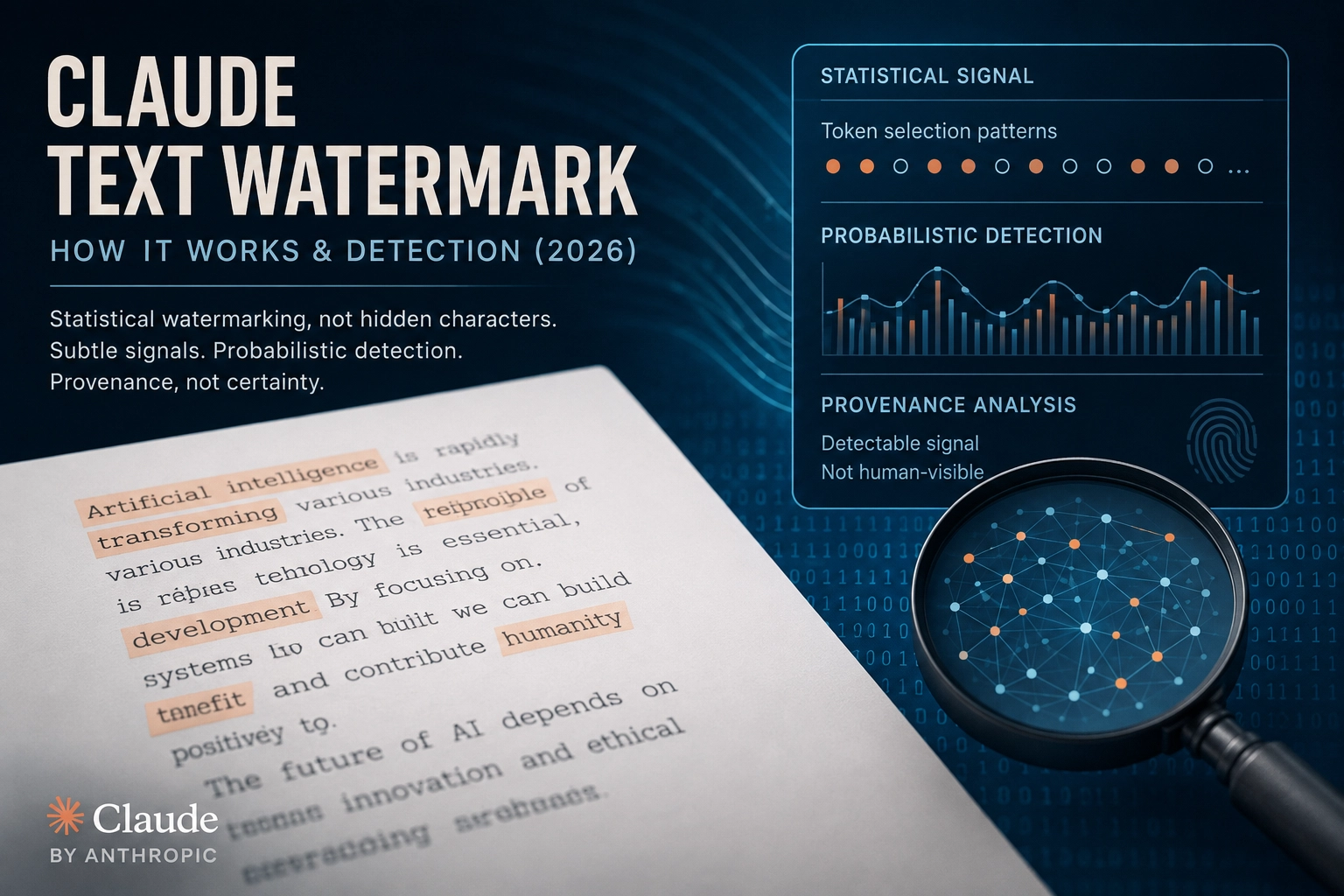
Anthropic is rolling out machine-readable watermarking for Claude-generated text. New models released under the new transparency regime are designed to support marking from launch, while support for existing models is being introduced progressively. Here is what the watermark actually is, what it is not, how detection works, and what writers and developers should know.
Claude watermark status — August 27, 2026
Models launched on or after August 2, 2026: marking is supported at launch. Existing models: support is being introduced progressively, so no assumption should be made that every historical Claude response carries the same signal. Detection: Anthropic has announced that it will soon offer a watermark detection API; no public production API is available yet. Until a supported verifier is available, a website that scans only invisible Unicode cannot honestly claim that it has read Claude’s statistical watermark.
Does Claude watermark text in 2026?
Yes—but the accurate answer needs an important qualifier. Anthropic is rolling out machine-readable marking for Claude-generated content in response to the new transparency requirements that began applying under the EU AI Act on August 2, 2026. Models launched in the EU on or after that date support marking at launch, while support for models released before that date is being added progressively.
That distinction matters because search results written only a few weeks earlier can now be factually stale. Until recently, an article saying “Claude does not have an official text watermark” could have been correct at publication time. It should not automatically be treated as correct after the August 2026 rollout.
The marking is also broader than the Claude.ai chat window. Anthropic describes it as a model-level capability, which means output from supported models can be produced through surfaces such as Claude’s API and Claude Code as well—not merely copied from the consumer chat interface.
| Question | Current answer | What it means |
|---|---|---|
| Does Claude watermark text? | Yes, on supported models | Text can contain an imperceptible statistical marking created during generation. |
| Is every historical Claude response watermarked? | No assumption should be made | Older models and older generations predate the current rollout. |
| Is the watermark a zero-width character? | No | Hidden Unicode and Claude’s statistical text watermark are separate mechanisms. |
| Can copy/paste preserve it? | Yes, potentially | The signal is tied to token/word choices rather than document formatting. |
| Can any public Unicode cleaner verify it? | No | A hidden-character scanner does not possess the statistical verification mechanism. |
| Are files/images marked the same way? | No | File and image provenance can use metadata standards such as C2PA; text needs a different approach. |
Reading the timeline: “Supported at launch” and “support being added” describe model coverage—not a claim that every response received today carries a watermark.
What exactly is the Claude text watermark?
When a supported Claude model generates text, a Claude text watermark is a machine-detectable statistical pattern introduced during generation. Instead of attaching a visible label or secret character after generation, the system can influence which acceptable token is selected at many generation steps. Across enough text, those small decisions form a pattern that a compatible detector can test.
That is a very different idea from putting a hidden string such as U+200B ZERO WIDTH SPACE inside a paragraph.
Consider a simplified example. A language model reaches this sentence:
The proposed architecture is technically ______.The model may have several reasonable continuations:
sound robust viable practical appropriateNormally, generation uses the probability distribution over those candidates plus the model’s sampling configuration. A statistical watermarking system can introduce a keyed signal into that decision process while still selecting a semantically acceptable token.
Conceptually, the generation pipeline looks like this:
Prompt + previous context ↓ Model predicts candidate tokens ↓ Candidate probability distribution ↓ Watermark-aware generation / keyed randomness ↓ One acceptable token is selected ↓ Process repeats across the response ↓ Many small choices accumulate into a detectable patternA detector with the appropriate verification mechanism does not search for one magic word. It analyzes the accumulated pattern across many generation decisions.
Important: the example above is conceptual
Anthropic has explained the high-level behavior of its watermark, but that does not make every implementation detail public. The simplified token examples on this page explain the class of technique; they should not be read as leaked Claude source code, a reverse-engineered key, or the exact production algorithm.
How does Claude’s statistical watermark work?
Large language models produce text token by token. At each step, the model generates a distribution describing which next tokens are plausible. Some contexts permit many equally reasonable choices; other contexts permit almost no freedom.
A watermarking system can take advantage of the high-choice moments. Rather than changing the meaning of the answer, it can subtly steer the random component of generation toward choices that correspond to a secret or controlled statistical pattern.
The important part is accumulation. One word is usually meaningless. Hundreds of eligible decisions can become evidence.
1. Claude generates a set of plausible next tokens
Suppose the model has already generated:
The new regulation creates a more transparent...Several completions might preserve the intended meaning. The language model already assigns probabilities to them.
2. Watermark-aware randomness influences eligible selections
Anthropic has described its system as changing the random generation process so word choices can collectively form a recognizable pattern. The crucial point is that the watermark is created during generation, not pasted into the finished paragraph afterward.
3. The signal is distributed across the text
Because the signal is statistical, there does not need to be a single character that says “Claude wrote this.” The evidence exists across a sequence of choices.
4. A compatible detector tests the sequence
The verifier can compare the observed text against the pattern expected from the watermarking scheme. Longer passages generally offer more eligible generation decisions and therefore more evidence than a ten-word answer.
Does Claude use Google SynthID?
Do not automatically equate Claude’s watermark with Google SynthID. Google DeepMind has publicly documented SynthID-Text, a watermarking architecture that modifies token probability scores during generation and later looks for the resulting statistical pattern. That makes SynthID a useful public reference for understanding how modern LLM text watermarking can work.
Claude’s publicly described behavior is conceptually similar: both approaches operate around probabilistic token generation rather than relying on a visible label. But unless Anthropic explicitly identifies its production implementation as SynthID, the technically correct wording is:
Claude watermark vs SynthID
Similar technical family does not mean identical implementation. SynthID-Text is a documented Google DeepMind system. Claude uses an Anthropic-controlled statistical watermarking mechanism. Public descriptions allow useful comparison, but they do not prove that Anthropic is running Google’s exact SynthID implementation or keys.
What Claude’s watermark is not
A large amount of confusion around “AI watermarks” comes from treating several unrelated signals as the same thing. They are not.
It is not a zero-width Unicode character
Characters such as U+200B (Zero Width Space), U+200D (Zero Width Joiner), U+2060 (Word Joiner), non-breaking spaces, bidirectional controls, and variation selectors can exist invisibly inside text.
They can be inserted by websites, editors, copy/paste operations, typography systems, malicious text manipulation, legitimate language shaping, or other software. Finding one may be technically interesting—but it is not proof of Claude’s new statistical watermark.
It is not an HTML attribute
Copied web content can carry formatting artifacts such as HTML attributes, rich-text markup, source references, or editor-specific metadata. Those can sometimes reveal where content was copied from, but they are not the model-level text watermark Anthropic is describing.
It is not an em dash detector
An em dash (—), colon-heavy prose, tidy bullet lists, phrases such as “it is important to note,” or any other stylistic habit can appear in both human and AI writing. Style classifiers may use patterns like these as weak features, but punctuation is not the watermark.
It is not simply “AI probability”
A generic AI-writing detector asks something like:
“How statistically similar is this text to writing produced by models in my training data?”
A watermark verifier asks a different question:
“Does this text contain the particular deliberately embedded pattern expected from this watermarking system?”
Those are fundamentally different tests.
Hidden Unicode ≠ Claude watermark
If a tool says “Claude watermark detected” only because it found a zero-width space, unusual dash, non-breaking space, or HTML artifact, it is not verifying Anthropic’s statistical watermark. At most, it has found a formatting or Unicode signal that should be reported separately.
Claude watermark vs hidden Unicode vs AI detector vs C2PA
| Method | What it analyzes | Can it verify Claude’s statistical text watermark? |
|---|---|---|
| Compatible Claude watermark verifier | Provider-specific statistical pattern | Potentially yes, when official/supported verification is available |
| Hidden Unicode scanner | Zero-width and unusual Unicode code points | No |
| Generic AI writing detector | Writing patterns, classifier features, model likelihood | No—not by itself |
| Stylometry | Vocabulary, sentence shape, punctuation, author-like patterns | No |
| C2PA verifier | Signed provenance credentials attached to supported media/files | Not the ordinary text watermark |
| Document metadata | Author/application/file properties | No |
Key distinction: Only a compatible provider-specific verifier can test Claude’s statistical mark; the other rows measure different signals.
How can a Claude watermark be detected?
Reliable Claude watermark detection requires a verifier that understands Anthropic’s watermarking scheme and has the required verification capability. A third-party tool cannot reconstruct official verification merely by counting punctuation or scanning for invisible Unicode. As of August 27, 2026, Anthropic has announced a forthcoming watermark detection API, but no public production API is available yet.
This is why the phrase “Claude watermark detector” currently covers two very different product categories in search results.
- Actual watermark verification: testing for the statistical signal Anthropic intentionally embeds.
- Supplementary forensic inspection: checking hidden Unicode, suspicious formatting, sample length, code density, repetition, and other characteristics.
The second category can be useful, but it should never be relabeled as the first.
If you want to inspect a passage without pretending a Unicode scan is official verification, use the Claude Watermark Checker. The tool separates hidden-character inspection and text characteristics from official watermark verification status rather than inventing a “Claude probability” score.
Why our checker does not show a fake “Claude 94%” badge
A percentage looks authoritative even when the underlying test cannot support it. Until a supported Claude verification provider is connected, an honest checker should say that official verification is unavailable and show only the evidence it can genuinely measure.
Can you detect Claude’s watermark with hidden characters?
No. A hidden-character scanner can tell you whether a piece of text contains characters that are invisible or easy to miss. It cannot tell you whether the token sequence matches Anthropic’s statistical watermark unless it also has access to the appropriate watermark-verification mechanism.
Hidden Unicode analysis still has legitimate uses. It can reveal:
- zero-width characters inserted accidentally during copy/paste;
- bidirectional controls that can make source text misleading;
- unexpected non-breaking spaces;
- soft hyphens and formatting artifacts;
- characters that break matching, indexing, code, or text processing.
It simply answers a different question.
Does copying and pasting remove the Claude watermark?
Ordinary copy and paste should not be expected to remove a statistical text watermark. Copying text from Claude into WordPress, Google Docs, Microsoft Word, Notion, email, Markdown, or a plain-text editor generally preserves the visible token sequence. Because the watermark lives in those generated choices rather than a special visual format, changing containers does not inherently erase the underlying pattern.
This is one of the key differences between statistical text marking and file metadata.
A metadata-based provenance record can sometimes be lost when software strips metadata. A token-level statistical pattern can survive format conversion as long as the actual wording remains substantially intact.
What happens when Claude text is edited?
Detection strength is not binary. Editing changes the sequence that the watermark detector sees.
A few punctuation corrections or wording changes leave most of a long passage untouched. A major rewrite replaces much more of the original generation path. Therefore, it is more accurate to think in terms of signal preservation and signal degradation than a magical on/off flag attached to the document.
| Transformation | Likely effect on the original signal | Important caveat |
|---|---|---|
| Copy / paste | Usually little effect | The visible wording remains essentially unchanged. |
| Formatting changes | Usually little effect | HTML, Markdown or document styling is not the core statistical signal. |
| Light human editing | May reduce but preserve substantial signal | Outcome depends on passage length and how much wording changes. |
| Heavy rewriting | Can substantially reduce the original signal | The resulting passage may no longer contain enough of the original generation sequence. |
| Translation into another language | Transforms the original token sequence heavily | A new Claude-generated translation can itself be subject to marking on a supported model. |
| Short proofreading pass | Depends on how much text Claude actually generates or replaces | AI involvement is not the same thing as AI authorship. |
Does Claude watermark translations?
If Claude is asked to generate a translation and the serving model supports watermarking, the translated output is still generated text. It should therefore not be treated as fundamentally exempt merely because the task is translation.
That is different from asking whether the original watermark survives when an already-generated passage is independently translated elsewhere. Translation replaces much of the original token sequence, so the original statistical evidence can change substantially.
This distinction is especially important in professional translation workflows. “AI processed this text” and “AI is the author of the underlying ideas” are not the same claim.
Does Claude Code add a watermark to code?
Claude Code is part of the broader Claude ecosystem, and Anthropic’s marking approach is implemented at the model level rather than as a decorative feature of the chat interface. However, code is a difficult medium for statistical text watermarking.
Natural-language prose often gives a model many acceptable ways to express the same idea. Code frequently does not. A function name, operator, literal, keyword, API method, or syntactic delimiter may have to be exact for the program to compile or behave correctly.
Anthropic has acknowledged this basic limitation: when generation has fewer safe alternative choices, there are fewer opportunities to alter sampling for watermark purposes without harming correctness.
So these two statements can both be true:
- Claude Code output can be generated through a watermark-capable Claude model.
- The detectable watermark density in exact code may be lower than in long-form creative prose.
For software provenance, repository history, signed commits, pull requests, code review, authorship records, and development logs remain useful forms of evidence that answer questions a text watermark alone cannot.
Why longer text is easier to watermark than short text
A statistical detector needs observations.
Imagine flipping a slightly biased coin twice. Two results tell you almost nothing. Flip it hundreds of times and the bias becomes easier to estimate.
Text watermarking faces a similar statistical constraint. A ten-word factual answer may contain very few discretionary generation decisions. A 2,000-word essay can contain far more.
This is why a trustworthy detector should distinguish:
- watermark verification result from
- sample suitability for verification.
A sample can be too short for a strong test without being human-written. Likewise, an unverified watermark does not automatically prove human authorship.
Why factual text and code can carry a weaker signal
Watermarking has to coexist with model quality.
If Claude is writing a fictional scene, many adjectives or sentence constructions may be equally valid. If Claude is returning an exact date, mathematical term, API property, quotation, legal clause, or programming keyword, the number of safe alternatives collapses.
A responsible watermarking system cannot simply choose a statistically convenient but incorrect token.
That creates a useful mental model:
High generation freedom → more eligible token choices → more opportunities to encode signal Low generation freedom → fewer safe token choices → less watermarking opportunityThis is also why a blanket statement such as “every Claude answer has the same watermark strength” is technically misleading.
Does a Claude watermark prove Claude wrote the document?
No. A watermark is evidence of model involvement, not a complete authorship verdict. A document may mix human paragraphs, Claude-generated passages, quotations, source material, code, edits, translations, templates, and text from other systems. Detection must therefore be interpreted as provenance evidence for the tested text—not automatic proof that Claude authored every idea or that the user contributed nothing.
This distinction matters in education, publishing, software development, legal review, client work, journalism, and corporate content workflows.
For example:
- A researcher can write an original paper and use Claude to improve one paragraph.
- A developer can design an architecture and use Claude Code to generate boilerplate.
- An editor can write an article and ask Claude to shorten a section.
- A translator can make the linguistic and terminology decisions while using an AI system for a first-pass draft.
A machine-readable mark may indicate that Claude processed or generated some resulting language. That alone does not resolve the human contribution, ownership, originality, or compliance question.
Can a Claude watermark identify the individual user?
Do not assume that “detectable watermark” means a public personal tracking ID is embedded inside each paragraph.
The publicly described purpose is to identify AI-generated or AI-processed content through machine-readable marking. That is different from embedding a visible account number, email address, subscriber identity, or user name into the text.
Questions about whether a provider keeps separate server-side generation records, logs, account metadata, or abuse-prevention telemetry belong to data retention and privacy policy, not automatically to the watermark itself.
A detector result should therefore never claim:
"Generated by [email protected]"unless a provider explicitly supports and documents that kind of attribution—which is not what is being described here.
Can Turnitin detect Claude’s new watermark?
Turnitin’s AI Writing Report and Claude watermark verification should not be treated as the same technology.
Turnitin publicly describes an AI-writing detection model that estimates whether qualifying prose likely originated from a large language model. Turnitin also explicitly warns that its AI-writing model can misidentify both human and AI text and should not be used as the sole basis for adverse action.
That is a classifier-based AI-writing assessment.
Claude watermark verification is provider-specific provenance detection.
Unless Turnitin publicly documents integration with Anthropic’s watermark verification mechanism, the safe conclusion is:
Turnitin detection is not automatically Claude watermark detection
Turnitin may classify a passage as likely AI-written for its own reasons. That does not mean it has found Anthropic’s private statistical watermark. If Turnitin later integrates an official Anthropic verifier, that would be a separate capability that should be evaluated from its current documentation.
Can GPTZero or other AI detectors detect the Claude watermark?
The same distinction applies to GPTZero, Originality-style tools, institutional classifiers, and other generic AI-writing detectors.
A detector may be very good or very poor at recognizing text that resembles Claude output. Either way, classifying Claude-like writing is not the same as verifying Claude’s intentional watermark.
A third-party system could eventually combine both:
- a general AI-writing classifier;
- an official Claude watermark provider;
- other provenance signals;
- document-history evidence.
But those results should remain separately labeled. Combining them into one opaque “AI score” makes the evidence harder—not easier—to interpret.
Why some Claude watermark detector pages are already outdated
The timing of Anthropic’s August 2026 rollout created an unusual search problem.
Pages indexed in June or July can confidently state:
“Claude has no official text watermark.”
A reader arriving from Google in mid-August may see that sentence without noticing the publication date.
Other pages use “watermark” as a marketing label for completely different things, including:
- zero-width Unicode;
- non-breaking spaces;
- HTML copy artifacts;
- em dashes;
- AI-writing style;
- generic “humanizer” scores.
Some of these signals are real technical phenomena. The problem is the label. Cleaning a zero-width space can be useful; calling that action “removing Claude’s statistical watermark” is a different and unsupported claim.
For fast-moving AI topics, always check the publication date, update date, provider documentation, and what the detector actually measures.
Can third-party Claude watermark checkers work today?
They can perform useful checks today, but they need to describe those checks accurately.
A responsible pre-verification tool can inspect:
- hidden and unusual Unicode;
- bidirectional controls;
- document length;
- word and sentence statistics;
- code-heavy versus natural-language content;
- repetition;
- whether a sample is structurally suitable for statistical analysis;
- whether an official Claude verification provider is currently connected.
It cannot turn those unrelated features into a cryptographic-looking “Claude 98.7%” result without a defensible model and methodology.
That distinction is the reason I built the Claude Watermark Checker as a provenance inspector first: it tells you what can actually be inspected and separates that evidence from official watermark verification.
What should a trustworthy Claude Watermark Checker show?
A good checker should expose evidence rather than hide everything behind one confidence badge.
| Result | How it should be labeled | What it must not imply |
|---|---|---|
| Official verification | Available / unavailable / result | Do not fabricate provider access. |
| Hidden Unicode | Exact code point + count | Do not call it Claude watermark evidence. |
| Sample suitability | Clearly marked heuristic | Do not display it as AI probability. |
| Text statistics | Characters, words, paragraphs, etc. | Do not infer authorship from word count. |
| Code-like content | Approximate structural signal | Do not claim code cannot be marked. |
| No verified watermark | Evidence not found / verification unavailable | Do not translate this into “human-written.” |
What does “no Claude watermark detected” actually mean?
This may become the most important interpretation rule of all.
Failure to detect a watermark is not automatically proof that a human wrote the text.
A negative or inconclusive result can have several explanations:
- the text was not generated by a supported Claude model;
- the passage is too short;
- the content has too little generation freedom;
- the passage is code or highly factual;
- the text has been substantially transformed;
- the verifier cannot access the correct provider mechanism;
- the text came from another AI system;
- the text is human-written.
A detector therefore needs an inconclusive state. Binary “AI / human” UX is attractive, but it often exceeds what the evidence can support.
Why is Anthropic adding watermarks now?
The immediate regulatory context is the European Union AI Act.
Article 50 transparency obligations began applying on August 2, 2026. European Commission guidance requires providers within scope to design systems so AI-generated or manipulated content can be identified through machine-readable marking, subject to the regulation’s scope, exceptions, and transitional provisions.
The Commission also provides a transition period for certain generative AI systems placed on the market before August 2, 2026. That helps explain why a provider can truthfully say “new models mark from launch” while still working through support for older models.
Anthropic’s documentation says marking will apply to output from supported models wherever Claude is offered, worldwide; that does not mean every historical model is already covered.
Regulatory context, not legal advice
This article explains the technical and product context around Article 50. Whether a specific company, workflow, publication, or use case satisfies the AI Act depends on the applicable role, content type, jurisdiction, human editorial control, exceptions, and final guidance. Use the European Commission’s current materials for compliance decisions.
What is C2PA, and how is it different from Claude’s text watermark?
C2PA is a provenance standard used to attach cryptographically signed information about the origin and editing history of supported digital media. It is particularly relevant to images and other files.
Text presents a harder problem.
If provenance exists only as file metadata, copying one paragraph into a new text box can detach the words from the original file. That is one reason statistical generation-time watermarking is attractive for plain text: the signal can travel with the wording rather than depending solely on the original file container.
The two mechanisms are therefore complementary:
| Feature | Statistical text watermark | C2PA-style provenance |
|---|---|---|
| Lives primarily in | Generated token/word pattern | Signed media/file provenance data |
| Visible to humans | Normally no | Metadata itself is not necessarily visually displayed |
| Copy plain paragraph | Pattern can travel with wording | File provenance may not travel with extracted text |
| Verification | Statistical/provider-specific detector | Credential/provenance verification |
| Best suited to | Generated text | Images and supported media/files |
Will Claude watermarking hurt writing quality?
A well-designed watermark should preserve the model’s normal quality by altering sampling only when suitable alternatives exist. That requirement is also why factual and code-heavy output cannot be treated exactly like creative prose.
The practical quality question is not:
“Did the model ever choose a different word?”
Sampling already involves choices among plausible continuations.
The meaningful questions are:
- Does marking measurably reduce factual accuracy?
- Does it reduce code correctness?
- Does it distort style?
- Does the detector produce acceptable false-positive and false-negative rates?
- How robust is detection after ordinary editing?
These are empirical questions. As Anthropic publishes more technical evaluation data, they should be judged from actual measurements rather than assumptions about the word “watermark.”
Does the watermark change copyright or ownership?
A provenance signal and a legal ownership determination are not the same thing.
Anthropic has said the presence of marking is intended to identify Claude involvement and does not itself rewrite ownership terms. Copyrightability, authorship, contractual disclosure, work-for-hire obligations, client policies, and jurisdiction-specific rules are separate questions.
This is particularly important for developers and professional writers. A watermark result might provide evidence that a tool participated in producing language or code; it does not automatically calculate the percentage of human creativity or resolve the legal status of the final work.
What Claude watermarking means for writers and publishers
For professional publishing, the strongest response is not to obsess over detector evasion. It is to build a defensible editorial process.
- Define permitted AI use. Drafting, research, proofreading, translation, summarization, and autonomous publication should not automatically share one policy.
- Keep source evidence. Preserve important references and research notes independently of the generated prose.
- Use real human review. A human editor should verify claims, quotations, names, dates, and conclusions.
- Record meaningful authorship. Keep drafts or revision history for work where provenance matters.
- Separate assistance from attribution. “Claude touched this text” is not automatically “Claude owns the ideas.”
- Follow publisher/client policy. Disclosure expectations can be stricter than the technical minimum required by a detector.
What Claude watermarking means for developers
For software teams, a text watermark is only one provenance layer.
Code review already has stronger workflow evidence available:
- Git history;
- signed commits;
- pull-request discussion;
- issue context;
- tests;
- architecture decisions;
- review approvals;
- CI logs.
These tell you who introduced, reviewed, approved, and shipped a change—questions a statistical watermark cannot answer by itself.
The sensible engineering approach is therefore provenance layering: use AI-content marking when relevant, but retain normal software-development controls.
What Claude watermarking means for educators
Educational use requires particular caution because an incorrect inference can directly affect a student.
Generic AI-writing classifiers already carry false-positive and false-negative risk. Turnitin’s own documentation says its AI-writing output should not be used as the sole basis for adverse action.
A future official Claude watermark result could provide a different and potentially stronger type of evidence for Claude involvement, but it would still need context:
- Was AI assistance permitted?
- Was the task proofreading or generation?
- Is only one passage marked?
- Was the source quoted?
- Was Claude used as a translation aid?
- Does institutional policy distinguish assistance from authorship?
Detection should start a review process, not replace one.
What Claude watermarking means for companies
Companies should treat provenance as part of their AI governance rather than a last-minute content problem.
A practical internal policy can specify:
- which AI providers are approved;
- what data may be entered;
- which outputs require human review;
- when AI assistance must be disclosed;
- how high-risk outputs are verified;
- how code contributions are reviewed;
- which provenance evidence is retained;
- how regulatory requirements are monitored.
If you are building AI into a publishing, WordPress, WooCommerce, reporting, or operational workflow, see my AI Workflow Automation work for the systems layer behind those controls.
Should you use a “Claude watermark remover”?
First determine what the product actually removes.
If a tool deletes U+200B, U+2060, non-breaking spaces, or other hidden formatting characters, it is a Unicode cleaner. That can be useful for document hygiene.
It should not claim:
Claude statistical watermark removed successfully.unless it has actually tested and neutralized the statistical watermark using a defensible methodology.
The safer terminology is:
Selected hidden Unicode characters removed.That describes the operation precisely without pretending one technical layer is another.
Can the Claude watermark be removed?
Statistical watermarks are designed to tolerate at least some ordinary transformations, but no text watermark should be treated as indestructible.
As language changes substantially, the original sequence of generation decisions changes with it. That is an inherent limitation of text watermarking and one reason verification systems report statistical evidence rather than pretending to be permanent serial numbers.
This article does not provide a watermark-evasion recipe. If your legitimate concern is document cleanliness, use a Unicode inspector. If your concern is authorship, retain revision history. If your concern is regulatory or client disclosure, follow the applicable policy instead of relying on formatting tricks.
What happens when Anthropic releases public detection access?
This will materially change the tool landscape.
Today, a third-party website can honestly inspect supplementary evidence while waiting for supported watermark verification. Once Anthropic exposes a documented production verification mechanism, a checker can add a provider layer such as:
User text ↓ Maksut.net verification endpoint ↓ Official Anthropic-compatible detector ↓ Normalized verification result ↓ Evidence reportAny secret provider credential should remain server-side. It should not be embedded into public JavaScript.
The result should also stay separate from generic AI-detection scores:
Official Claude watermark verification: [result] Hidden Unicode inspection: [result] Sample suitability: [heuristic] Generic AI classifier: [if ever offered, clearly separate]That is the architecture behind the Claude Watermark Checker: add stronger provenance evidence when it genuinely becomes available instead of redesigning the product around a misleading score.
Claude watermarking and the bigger AI provenance shift
Claude is only one part of a broader transition from “Can this detector guess whether AI wrote it?” toward provider-generated provenance.
Google DeepMind has already documented SynthID across several media types. C2PA is being adopted as a provenance standard for digital media. The EU AI Act is pushing providers toward machine-readable marking. Other major AI companies face the same transparency environment.
That creates a future stack with several evidence layers:
AI provenance │ ├── Provider watermark │ ├── Claude statistical text watermark │ └── SynthID-style systems │ ├── Signed provenance │ └── C2PA │ ├── Document / platform history │ ├── Generic AI-writing classification │ └── Human editorial evidenceNo one layer answers every question.
That is why the more useful long-term product category is not simply “AI detector.” It is an AI provenance inspector: a system that tells you which evidence exists, which evidence does not, and how strong each conclusion actually is.
Practical checklist for Claude-assisted content
- Know which Claude model and workflow you used.
Watermark rollout is model- and date-sensitive. Do not assume a 2025 generation and an August 2026 generation have identical provenance behavior.
- Separate AI assistance from AI authorship.
Proofreading, translation, ideation, drafting, coding, and autonomous publishing involve different levels of model contribution.
- Keep revision evidence when authorship matters.
Version history, commits, editorial drafts, notes, and citations provide context a watermark cannot.
- Do not mistake hidden Unicode for the statistical watermark.
Inspect Unicode when necessary, but label the finding accurately.
- Use official verification when available.
Provider-specific evidence is more meaningful than a site that guesses from punctuation.
- Treat inconclusive results as inconclusive.
No verified watermark does not automatically mean human-written.
- Apply human review to consequential work.
Watermarking does not verify factual accuracy, legal compliance, security, or code correctness.
- Re-check policy and technical documentation.
August 2026 is the beginning of a rapidly changing provenance regime, not the final state.
Sources and methodology
This article prioritizes current Anthropic documentation and primary regulatory guidance, then uses public technical literature on statistical text watermarking and supplementary reporting for context. Where Anthropic has not publicly specified an implementation detail, this article does not invent one.
- Anthropic: How Claude’s text watermark works — official technical explanation of the SynthID-Text variant, Anthropic key, limitations, and forthcoming detector API; How Claude marks AI-generated content — official documentation on launch coverage, embedded text watermarks, detection plans, and limitations.
- European Commission: Guidelines on transparency obligations under Article 50; Quick facts: transparency rules for AI systems.
- European Commission: Code of Practice on Transparency of AI-generated Content.
- Google DeepMind: SynthID overview and text watermarking explanation; technical explanation of token-probability marking.
- Research: Scalable watermarking for identifying large language model outputs, Nature.
- Turnitin: AI Writing Report documentation and limitations.
- Supplementary reporting: The Verge — Claude text and image marking; Business Insider — Anthropic’s watermark explanation and limitations.
Research cut: August 27, 2026. Claude’s model coverage and public detector availability are moving quickly. Re-check Anthropic’s current documentation before relying on any static list of supported models or verification capabilities.
FAQ: Claude text watermarking
- Does Claude have a watermark?
-
Anthropic is rolling out imperceptible machine-readable marking for text generated by supported Claude models. Its current documentation says models launched in the EU on or after August 2, 2026 support marking at launch, while support for models released before that date is being added progressively. Do not assume every historical Claude response carries the same watermark.
- Is Claude’s watermark a hidden Unicode character?
-
No. Claude’s new text watermark is statistical rather than a secret zero-width character. Zero-width spaces, joiners, unusual whitespace, and other Unicode characters can be inspected separately, but their presence does not verify Claude’s statistical watermark.
- How does the Claude text watermark work?
-
At a high level, the model’s generation randomness is influenced so that many otherwise-valid token or word choices collectively form a machine-detectable statistical pattern. The signal accumulates across text rather than depending on one magic character or phrase.
- Does Claude use SynthID?
-
Yes—with an important qualifier. Anthropic now says Claude’s text watermark is a version of the SynthID-Text approach published by Google DeepMind. Claude uses Anthropic’s own watermark key, so public SynthID concepts do not give a third-party site access to official Claude verification.
- Can I detect Claude’s watermark with an online checker?
-
A checker can inspect hidden Unicode and other text characteristics, but official Claude watermark verification requires a compatible provider-specific detector. Anthropic has announced that it will soon offer a watermark detection API; no public production API is available yet. A tool should clearly state whether official verification is actually available.
- Does copying and pasting remove the Claude watermark?
-
Ordinary copy and paste should not be expected to remove a statistical watermark because the visible sequence of words largely remains the same. The signal is not dependent on keeping the original Claude webpage or document formatting.
- Does editing remove the Claude watermark?
-
Light editing may leave substantial statistical evidence intact, while extensive rewriting changes more of the original token sequence and can weaken detection. Exact behavior depends on the passage, model, length, and verification system.
- Does Claude watermark code generated by Claude Code?
-
Claude Code can use watermark-capable Claude models, but code offers fewer safe alternative token choices than creative prose. That can make statistical marking less dense or detection more difficult. A watermark also does not replace Git history, code review, or signed development provenance.
- Does Claude watermark translations?
-
A translation newly generated by a supported Claude model can be subject to marking because it is still generated output. Separately translating an already-watermarked passage substantially changes its token sequence, so the original signal should not be assumed to survive unchanged.
- Can Turnitin detect Claude’s watermark?
-
Turnitin’s documented AI Writing Report is a general AI-writing classifier, not automatically an Anthropic watermark verifier. Unless Turnitin explicitly documents an integration with Claude’s official watermark detection mechanism, the two results should be treated as separate forms of evidence.
- Can GPTZero detect Claude’s watermark?
-
A generic AI detector may estimate that text resembles AI-generated writing, including Claude-like output, but this is different from verifying Anthropic’s deliberately embedded statistical watermark. Provider watermark detection and AI-writing classification should be reported separately.
- Can a zero-width character remover remove Claude’s watermark?
-
No claim like that should be made from Unicode cleaning alone. Removing zero-width characters can clean formatting artifacts, but Claude’s statistical watermark is not simply a zero-width Unicode marker.
- Does a Claude watermark prove that Claude authored the entire document?
-
No. It can provide evidence of Claude involvement in tested text, but documents may mix human writing, AI-generated passages, quotations, translations, code, and edits. Provenance evidence must be interpreted in context.
- Does “no watermark detected” prove the text is human-written?
-
No. A passage may be too short, heavily edited, factual, code-heavy, generated by another AI system, produced by a non-watermarked model, or outside the verifier’s capabilities. A negative or unavailable watermark result is not automatically proof of human authorship.
- Why did Anthropic introduce Claude watermarking?
-
The immediate context is the EU AI Act’s Article 50 transparency requirements, which began applying on August 2, 2026 and require machine-readable marking for AI-generated or manipulated content within scope. Anthropic has been rolling out marking globally while preparing broader detection access.
Related resources
Build AI workflows you can actually audit
If AI is part of your content, WordPress, WooCommerce, development, reporting, or publishing workflow, provenance should not be an afterthought. I build AI-assisted systems with human review, structured outputs, traceable workflows, and the technical SEO/AEO layer connected from the start.
Want to inspect text first? Use the Claude Watermark Checker · Explore AI Workflow Automation.
Discussion
0 comments
No comments yet.
Have a technical question, correction or a different interpretation? Add to the discussion.