Reading progress
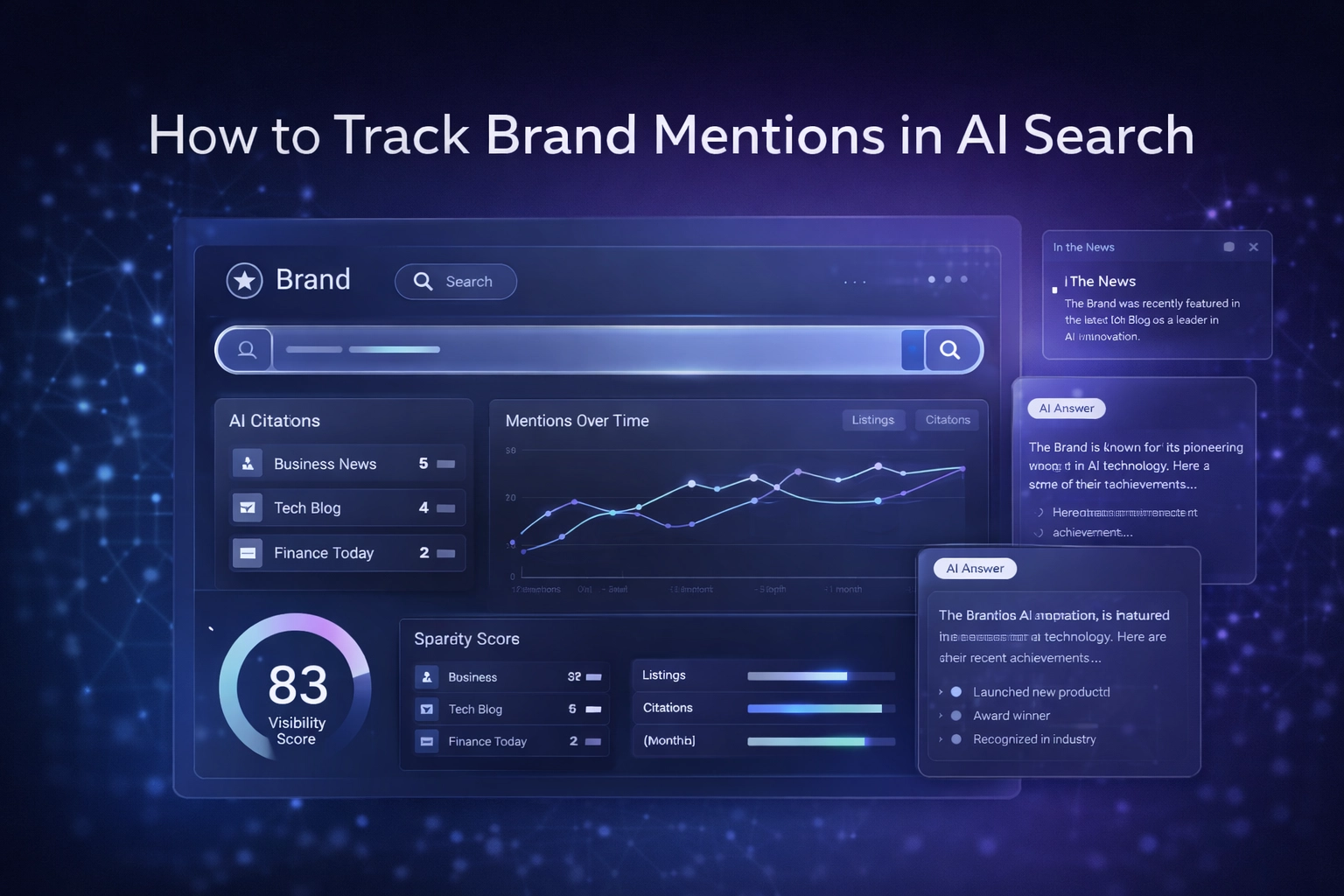
A cross-platform measurement model for seeing where your brand is mentioned, recommended or cited—and turning the evidence into market-specific SEO, content, authority and conversion work.
What counts as an AI brand mention?
Track distinct outcomes instead of one yes/no field:
- Mention: the answer names the brand, product or identifiable organisation.
- Recommendation: the brand is presented as a suitable option for the user’s need.
- Owned citation: the answer or source panel links to your domain.
- Third-party influence: an external source about your brand is linked or appears to shape the answer.
- Accuracy: the brand description is correct, incomplete, outdated or false.
A mention is not automatically a citation, a citation is not automatically a recommendation, and none of them alone proves a lead. Keeping the outcomes separate makes the report actionable.
Step 1: Build a shared prompt framework
Start with questions customers ask before buying. Use sales calls, support tickets, on-site search, Search Console, community discussions and competitor research. Include:
- Discovery: “Who are the best [category] providers for [audience]?”
- Problem: “How should a [business type] solve [specific issue]?”
- Comparison: “[Brand] vs [competitor] for [use case].”
- Alternatives: “What are alternatives to [competitor]?”
- Validation: “Is [brand] suitable for [requirement]?”
- Transactional/local: “Who provides [service] in the UK?” or the relevant city/country.
Do not include your name in every question. Branded prompts test reputation and accuracy; unbranded prompts test discovery and competitive visibility.
Step 2: Separate engine, surface, country and language
| Dimension | Why it must be separate | Example |
|---|---|---|
| Engine/product surface | Retrieval, citations, interfaces and personalisation differ | ChatGPT, Gemini app, Google AI Mode, Perplexity |
| Country | Sources, competitors and commercial expectations vary | United Kingdom vs United States |
| Language | Literal translation can change the query and evidence pool | Locally written Turkish vs translated English |
| Audience/funnel | A buyer and a student ask different questions | Comparison prompt vs definition prompt |
| Session conditions | Account, history and conversation context can affect an observation | New thread, signed-in state, selected mode |
For a multilingual site, write prompts from local SERPs and real language use. Do not copy a US prompt list into the UK or translate it word for word into Turkish, German or Spanish.
Step 3: Record one row per observation
Use a spreadsheet or database with:
Date · engine/surface · country · language · audience · exact prompt · session/mode notes · brand outcome · recommendation context/order · competitors · owned URLs · third-party URLs · accuracy · saved answer/screenshot · next action.
Preserve enough evidence for another person to understand why the result was classified. A percentage without its answer, sample and conditions is difficult to audit.
Step 4: Sample consistently
- Use a new conversation for each saved prompt unless follow-up behaviour is the thing being tested.
- Keep the exact wording, market and product surface unchanged for comparable observations.
- Repeat important questions because generated answers can vary; report the number of observations.
- Use a fixed cadence: weekly during active work, monthly for a stable strategic baseline.
- Save answer and source evidence where the product and your policy permit it.
- Mark interface or model changes; do not compare unlike conditions as if they were one continuous ranking.
Step 5: Calculate transparent metrics
- Mention rate: comparable observations naming the brand divided by all comparable observations.
- Recommendation rate: observations recommending the brand divided by the sample.
- AI share of voice: your mentions divided by mentions of all tracked brands in the same sample.
- Owned citation rate: observations linking to your domain divided by the sample.
- Accuracy rate: accurate descriptions divided by observations that mention the brand.
- Commercial coverage: revenue-relevant prompts where the brand is recommended or accurately represented.
Always publish engine, market, date range and sample size beside a rate. Keep engine-level results visible before rolling anything into an executive summary.
Use Google Search Console without overclaiming
Google says normal SEO fundamentals remain relevant to its AI search features and that AI Overviews and AI Mode performance is included in Search Console. In June 2026 Google announced dedicated Search Generative AI reports for eligible properties. Use the report’s pages, countries, devices and dates to understand Google AI search exposure.
Search Console does not measure standalone ChatGPT, Gemini-app or Perplexity answers. For those, use direct sampling or a documented monitoring platform. Analytics may show some referrals, but missing referral data does not prove that the brand was absent from an answer.
Connect visibility to analytics and leads
- Annotate known AI referral sources in analytics and preserve landing-page paths.
- Track clicks from supporting articles to the AEO tools and AI SEO service.
- Add “How did you hear about us?” or an equivalent sales field so dark or assisted discovery can be reported.
- Review branded-search changes and direct visits as supporting signals, not automatic attribution.
- Qualify enquiries by market, service, budget and problem; raw traffic is not the revenue KPI.
Turn the log into a prioritised action queue
| Finding | Likely action |
|---|---|
| Competitor recommended; you absent | Inspect the question, cited sources and best competitor page; create or improve a distinct commercial-intent asset |
| Brand mentioned inaccurately | Correct first-party facts, entity details, documentation and credible third-party profiles repeating the error |
| Third-party source drives the answer | Pursue legitimate reviews, expert contribution or digital PR where the audience and editorial fit are real |
| Page found but not selected repeatedly | Improve the direct answer, evidence, authorship/source transparency, headings and internal ownership |
| UK and US outcomes differ | Use market-specific terminology, proof, offers and landing pages; do not duplicate one global narrative |
| Mentions rise but leads do not | Review prompt quality, landing-page offer, CTA, trust proof and lead tracking |
Manual tracking or automated software?
Start manually when you have a small prompt set. Automation becomes useful for several engines, markets, clients, competitors or long-term history. Evaluate software with the AI search analytics tools comparison; require answer evidence, regional controls, exports and a clear collection method.
Build an AI search visibility roadmap
Monitoring should change what you publish, fix, prove or promote. Maksut.net’s AI SEO and search visibility service combines market-specific prompt research, technical access, content ownership, entity consistency, authority and conversion measurement into one prioritised plan.
AI brand mention monitoring FAQ
Can Google Analytics track AI brand mentions?
No. Analytics can report some visits from AI products, but a mention can occur without a click. Sample the answers separately and connect them to referral and lead data.
How often should AI mentions be checked?
Use a consistent cadence matched to the decision. Weekly checks suit active launches and optimisation; monthly checks are often sufficient for a strategic baseline.
Can I combine all engines into one score?
You can create an executive roll-up only after preserving engine, market and prompt-level results. An unexplained blended score hides which product or buyer question actually changed.
Should prompts be translated for every country?
Localise them from local search behaviour, vocabulary and buying conditions. Literal translation can alter intent and miss the sources and competitors used in that market.
Can AI search understand your page?
Start with one URL. Check technical access, structured data and content clarity to find where your next improvement should begin.
Measures on-page AI search readiness, not live cross-engine brand mentions.
SEO & AI Search Services




Maksut Maksutoğlu

Send a note
Have a correction, suggestion or a different interpretation? Send me a note.
SEND A NOTE