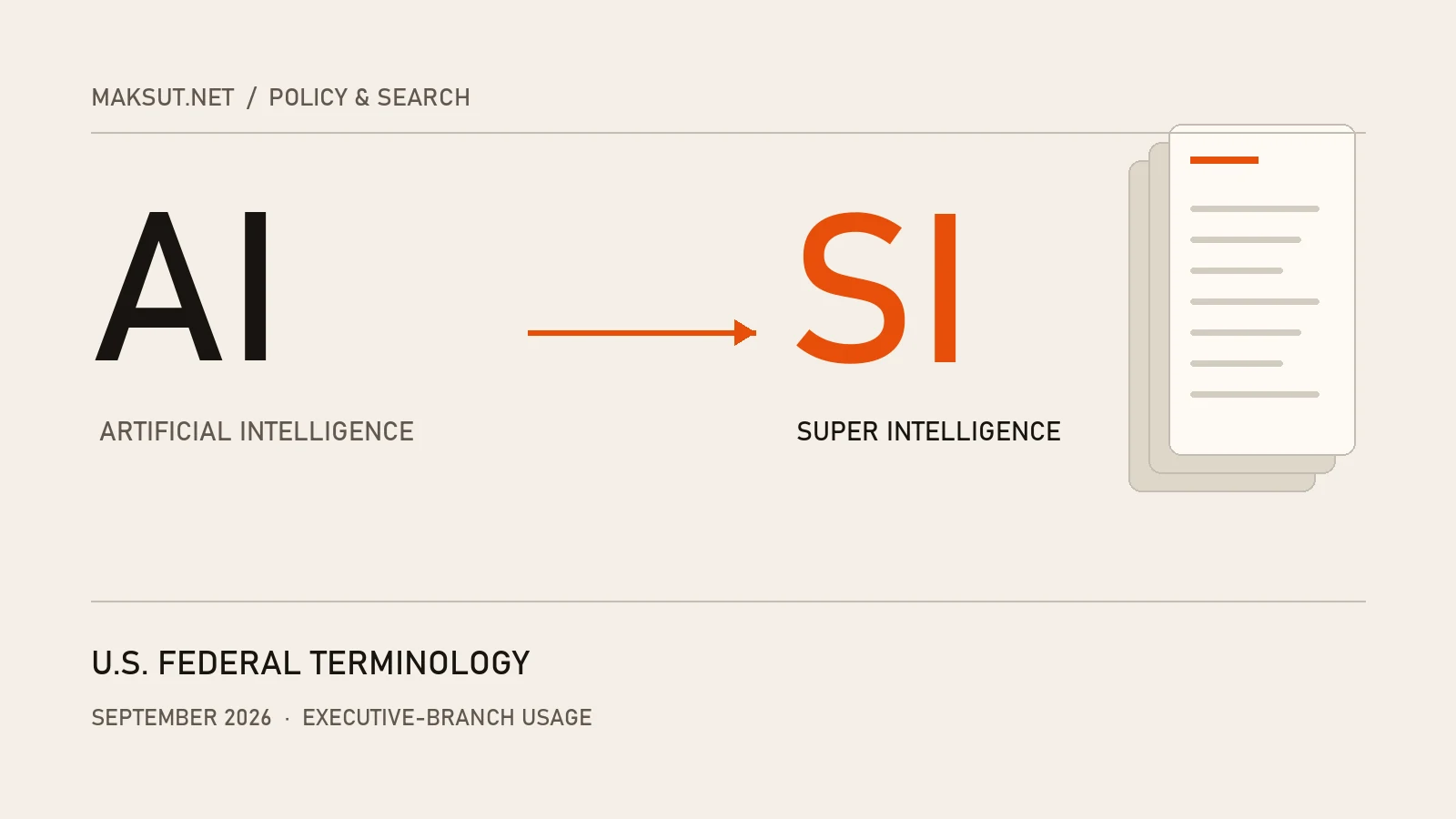
On September 29, 2026, President Donald Trump signed an executive order directing the U.S. federal executive branch to use “Super Intelligence” (SI) in place of “Artificial Intelligence” (AI) in specified official communications. The change does not rename the field worldwide or require private organisations to adopt SI.
Published: September 30, 2026. This guide explains the order’s scope and the difference between federal SI and technical superintelligence. The controlling source is the September 29 executive order.
What did the executive order change?
The order, titled “Inaugurating the Era of Super Intelligence,” sets a terminology policy for executive departments and agencies. Where law permits, they are directed to replace “Artificial Intelligence” and “AI” with “Super Intelligence” and “SI” in:
- official correspondence and public communications;
- federal websites, reports and policy documents;
- other non-statutory executive-branch documents.
This is a formal policy for federal executive communications, rather than a general renaming of all AI. The order repeatedly limits implementation to the maximum extent permitted by law.
What did not change?
The order does not require previously issued regulations, presidential actions, contracts, grants or historical documents to be rewritten. It does not require universities, private companies, publishers or international standards bodies to replace AI in their own work.
Section 3 is especially important: for purposes of this order, SI currently means the technologies covered by the existing definition of artificial intelligence in 15 U.S.C. § 9401(3), unless a later lawful action changes that position. A new statutory technology category has therefore not yet been enacted.
Why did the administration choose “Super Intelligence”?
The order argues that modern frontier systems exceed what was envisioned when the name Artificial Intelligence emerged roughly 70 years ago, and says SI better conveys their capabilities and potential. In remarks on September 29, Trump gave a more informal explanation: he said he disliked the word “artificial” and compared it with “fake news.” His remarks explain his preference; the executive order defines the policy.
Federal SI and technical superintelligence are different uses
“Superintelligence” already had a meaning in AI research. OpenAI’s superalignment explanation uses it for systems much smarter than humans and distinguishes it from AGI. Google DeepMind’s 2026 From AGI to ASI report discusses artificial general superintelligence as a stage beyond human-level AGI. The federal order currently uses SI for a much broader set of technologies under the existing legal AI definition.
| Term | Typical meaning |
|---|---|
| AI — Artificial Intelligence | The broad category of artificial-intelligence systems and technologies. |
| SI — U.S. federal usage | The executive branch’s new term for technologies currently within the statutory AI definition. |
| AGI — Artificial General Intelligence | A term for broadly general or human-level AI capabilities; definitions vary. |
| ASI — Artificial Superintelligence | Typically a hypothetical or future capability level substantially beyond humans. |
When reading a government document, check which definition it uses. Federal SI should not automatically be read as a claim that today’s systems meet the technical ASI threshold.
Should everyone now say SI instead of AI?
No. Artificial Intelligence and AI remain established terms in technology writing, research, marketing and international communication. The new SI usage has a specific U.S. federal executive-branch context. Replacing every AI reference on a commercial website would obscure that distinction.
A clear formulation is: The U.S. executive branch uses “Super Intelligence” (SI) in place of “Artificial Intelligence” (AI) in specified official communications. This describes both the new usage and its limit.
Does this change AI SEO or AI search optimization?
There is currently no reason to rename AI SEO, AI Search, AI Overviews or AI visibility as “SI SEO.” Those remain the terms used by products, practitioners and searchers. Maksut.net’s AI search optimization service and AEO glossary continue to use the established terminology.
For search and answer engines, the useful editorial task is to explain the relationship Artificial Intelligence → AI → Super Intelligence → SI in the federal-policy context while keeping technical superintelligence / ASI distinct. A query about “U.S. Super Intelligence policy” may point to this order; a question about when superintelligence will arrive asks about a different concept. Search systems may associate these terms contextually, but universal synonymy would be an unwarranted assumption.
What happens next?
Within 60 days of the order, the Assistant to the President for Science and Technology must submit proposed legislative language for a federal definition of SI. The proposal should assess whether to modify, expand or replace the existing AI definition, whether statutory references need amendment, and whether further executive action is necessary.
A proposal is not a law. As of September 30, 2026, the executive-branch terminology has changed in specified communications; the statutory definition has not been replaced by a new SI definition.
What should businesses and publishers do?
- Keep using AI where it matches user language and industry terminology.
- When U.S. federal policy is relevant, explain SI on first mention and link to the order.
- Distinguish the order’s SI from technical ASI or superintelligence.
- Review this page if the proposed federal definition materially changes the legal relationship between AI and SI.
Editorial note: We will update this page if the proposed federal definition of Super Intelligence changes the legal relationship between AI and SI.
Frequently asked questions
- Did Trump officially rename AI to Super Intelligence?
He signed an order directing the federal executive branch to use SI instead of AI in specified non-statutory communications. It does not impose that terminology on the private sector or the rest of the world.
- Is AI now called SI throughout the United States?
No. SI is prescribed for the executive-branch contexts covered by the order. AI remains established in existing law, research, business and international usage.
- Is SI the same as ASI?
Not in this order. Federal SI currently maps to the existing statutory AI definition. Technical ASI usually refers to capabilities substantially beyond humans.
- Should websites replace “AI” with “SI”?
There is no general requirement or demonstrated SEO reason to do so. Explain SI where the U.S. federal terminology is relevant.
- Will the legal definition of AI change?
Possibly. The order requires a legislative proposal within 60 days, but it does not guarantee that Congress will enact a new definition.
Read in Turkish: ABD’de AI ve Super Intelligence (SI) kararını okuyun.
Discussion
0 comments
No comments yet.
Have a technical question, correction or a different interpretation? Add to the discussion.